
- All
- Product Name
- Product Keyword
- Product Model
- Product Summary
- Product Description
- Multi Field Search
Author: Site Editor Publish Time: 2026-07-20 Origin: Site

Residential furniture fails quickly in hospitality environments. You cannot expect home furniture to survive constant daily traffic. The continuous stress of patrons sitting, leaning, and moving seats destroys weak frames rapidly. Selecting the right seating directly impacts table turnover rates. It also dictates your cleaning overhead and manages serious liability risks.
Moving past aesthetic preferences helps you evaluate contract-grade durability. You must prioritize spatial efficiency and structural integrity over simple visual appeal. Restaurant operators must carefully balance upfront pricing against long-term operational resilience. Ignoring these factors leads to frequent replacements and disrupted dining services. A beautiful seat means nothing if its legs wobble after three months.
We offer a practical framework for evaluating and sourcing commercial dining chairs. This framework aligns perfectly with your specific operational demands and budget constraints. You will learn how to choose robust materials and master space planning metrics. We will also guide you through complex industry certifications. Finally, you will discover how to avoid common, costly procurement traps.
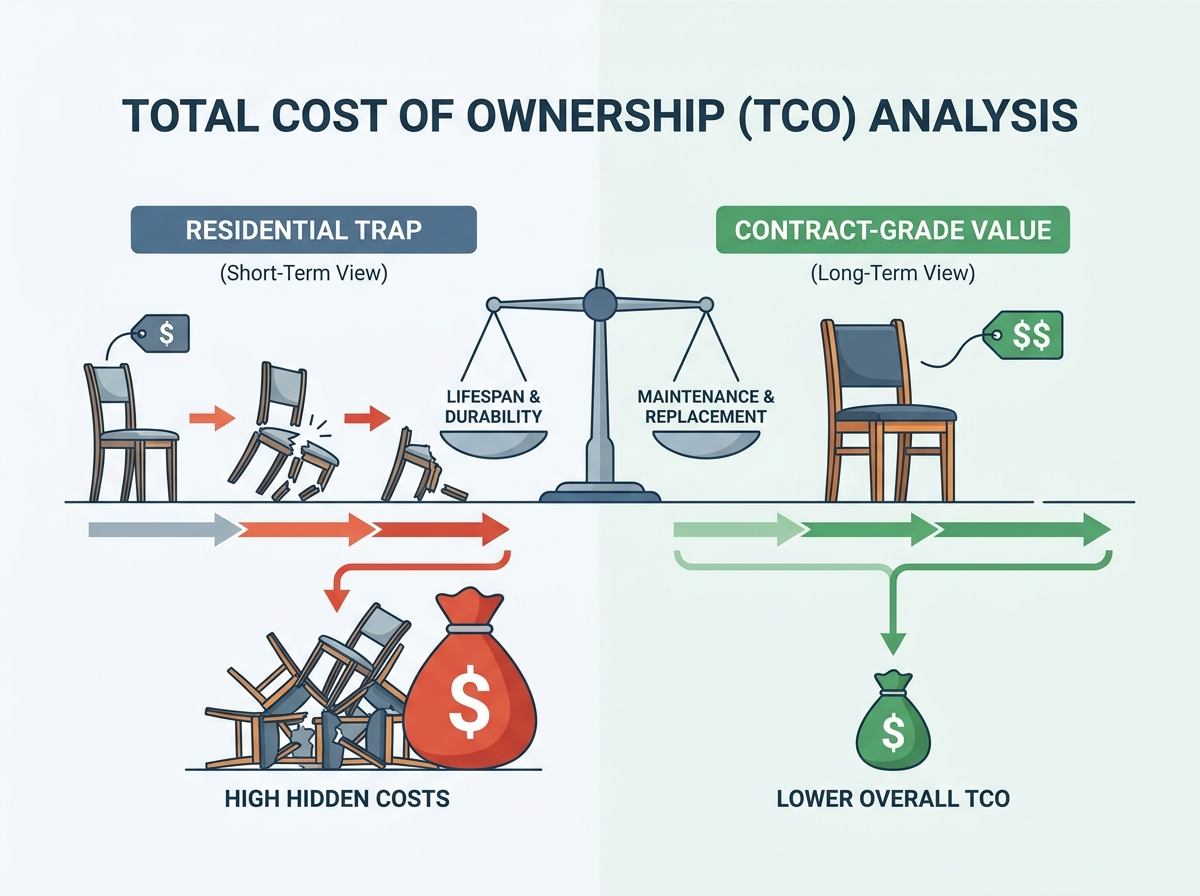
You must avoid the residential trap at all costs. Buying cheaper, non-commercial chairs always results in higher long-term expenses. Home chairs break down fast under constant stress. They simply lack the internal engineering to handle guests shifting and dragging them daily. This structural failure leads to frequent, expensive replacements.
Furthermore, commercial environments instantly void residential furniture warranties. Manufacturers know their home products cannot survive restaurant usage. Using uncertified chairs creates major liability risks for your business. If a weak chair collapses under a patron, you face severe legal and financial consequences. Your insurance policy might even deny the claim.
We must match chair durability directly to your specific business model. Turnover alignment plays a massive role in successful procurement. High-turnover quick-service restaurants require extremely rigid surfaces. Staff must wipe these surfaces clean in mere seconds. You need chairs built to handle rapid, endless guest seating transitions throughout the day.
Fine dining establishments operate quite differently. They require sophisticated ergonomic support for much longer dwell times. Guests stay longer, so comfort directly dictates their overall dining experience. Selecting proper commercial dining chairs ensures you balance upfront pricing against real-world lifespan. You build a safer environment while protecting your initial investment.
Wood offers a truly classic and inviting aesthetic. You can refinish wood surfaces easily when they wear down over time. This material brings immediate warmth and an upscale feel to any dining room. However, wood remains highly susceptible to surface scratching. Patrons sliding rivets or zippers across the seat will damage the finish.
Wood frames require specialized joinery to survive daily abuse. Mortise-and-tenon joints provide essential structural integrity. Reinforced corner blocks help the chair withstand frequent tilting by guests. Staff must polish and maintain wood regularly to preserve its premium finish. Ignoring maintenance allows moisture to penetrate and warp the frame.
Metal provides an incredibly high strength-to-weight ratio. Aluminum and steel dominate this demanding category. Fully welded joints completely eliminate loosening over time. Metal frames rarely suffer from wobbly legs. Aluminum is naturally rust-resistant. This intrinsic quality makes it perfect for outdoor patios and high-humidity areas.
However, metal surfaces can feel cold to the touch. They also require high-quality powder coating to prevent unsightly chipping. Powder coating bakes the color onto the metal. This creates a much harder shell than standard wet paint. You must inspect metal frames regularly for deep scratches exposing raw steel.
Polypropylene and resin offer seamless, highly modern designs. Staff can sanitize these smooth plastics effortlessly between seatings. They are almost always stackable. This stacking feature makes them ideal for high-traffic environments or seasonal outdoor use. You can easily store them away during the winter months.
Unfortunately, untreated resin remains susceptible to UV fading. Constant sun exposure turns bright colors dull and chalky. You must ensure the manufacturer adds UV inhibitors during production. Plastic seating may also project a lower perceived value in premium dining spaces. You should reserve them mostly for fast-casual or outdoor venues.
Upholstery requires strict operational scrutiny. Commercial spaces demand a minimum 50,000 to 100,000 double-rub count. We measure this durability using the standardized Wyzenbeek test. A machine rubs the fabric back and forth until the fibers break. Higher scores guarantee longer survival in your restaurant.
Fabrics must feature heavy-duty, built-in stain-resistant treatments. Crypton technology works wonderfully in busy dining rooms. It stops liquids from penetrating the woven fibers. Alternatively, you can specify commercial-grade vinyl or polyurethane. These waterproof materials allow for easy, immediate wipe-downs after messy spills.
| Material | Primary Pros | Primary Cons | Ideal Venue Match |
|---|---|---|---|
| Wood | Classic aesthetic, easily refinished | Prone to scratches, needs tight joints | Upscale Dining, Steakhouses |
| Aluminum | Rust-resistant, lightweight, welded | Can feel cold, requires powder coating | Patios, Outdoor Cafés |
| Steel | Maximum structural strength | Heavy, susceptible to rust if chipped | Industrial Breweries, Bars |
| Polypropylene | Seamless, highly cleanable, stackable | Prone to UV fading, lower perceived value | Quick-Service, Food Courts |
| Commercial Vinyl | Waterproof, instant spill recovery | Can tear if punctured, lacks breathability | Diners, Family Restaurants |
Footprint and aisle clearance dictate your entire floor plan. The leg splay of a specific chair affects how many tables fit inside the room. A wider leg base steals valuable square footage rapidly. You must carefully calculate the necessary gaps between seating and traffic lanes.
Seat height must match table height perfectly. Standard commercial dining chairs require an 18-inch seat height. This specific measurement pairs correctly against standard 30-inch high dining tables. This ratio provides approximately 10 to 12 inches of legroom.
Any deviation causes immediate discomfort for your guests. If the seat sits too low, diners feel like children at the table. If the seat sits too high, they bang their knees against the tabletop. Always measure the distance from the floor to the top of the uncompressed seat cushion.
You must decide between armrests and armless designs carefully. Armchairs improve guest comfort significantly. Older guests particularly enjoy resting their arms during long, multi-course meals. However, armchairs demand wider tables to accommodate their bulk.
Armchairs reduce total seating density across your floor plan. They also pose a unique spatial challenge. They must clear the table apron when guests push them in. If the armrests hit the wooden apron, they will chip the furniture constantly. Armless designs maximize density and eliminate this clearance issue entirely.
Stackability remains an absolute necessity for dynamic, multi-use spaces. Cafés cleaning floors nightly benefit massively from lightweight, stackable seating. Staff can clear the entire dining room in minutes. You must evaluate stacking limits carefully before purchasing.
Some heavy models safely limit stacking at four units high. Other engineered resin designs safely stack ten units high without tipping. Always check the cart requirements. Moving stacked chairs safely requires proper transport equipment. Dragging heavy stacks across the floor damages the bottom chair and ruins your flooring.
Never ignore commercial testing standards. BIFMA and ANSI testing establish the industry benchmark for safety. These organizations conduct aggressive dynamic drop tests. They drop heavy weights onto the seat repeatedly. They also execute rigorous back pull tests to simulate leaning patrons.
These specialized tests establish a reliable baseline for structural integrity. They prove the frame will not fail under immense daily pressure. Purchasing tested seating protects your patrons from injury. It also protects your business from devastating negligence lawsuits.
Weight capacity cannot be compromised in the hospitality industry. Standard commercial dining chairs should support a minimum of 250 to 300 lbs. You must accommodate diverse body types comfortably and securely.
Heavy-duty models must support 500 lbs or more. These reinforced units utilize thicker metal tubing or robust corner blocking. Accommodating all guests safely remains your primary responsibility as an operator. Weak frames bend over time and eventually snap during peak service hours.
Fire safety compliance protects your business, staff, and patrons. Upholstered chairs must meet local municipal fire codes. Standards like CAL 117-2013 apply strictly to commercial hospitality spaces. This specific standard ensures the interior foam resists smoldering.
Fire inspectors will check these compliance tags during routine building audits. Missing tags result in heavy fines or forced removal of the furniture. Always demand written proof of fire compliance from your supplier. Do not assume imported residential fabrics meet these rigorous safety metrics.
You must watch out for common warranty traps. Learn how to read contract-grade warranties correctly before signing any purchase order. Always differentiate between structural warranties and cosmetic warranties. Suppliers often hide limitations deep in the fine print.
Lead times can easily disrupt your grand opening schedule. You must clearly differentiate between stock inventory and custom orders. Stock items sit ready in domestic warehouses. They generally ship to your location quickly. You can often receive stock seating in under two weeks.
Custom upholstery or unique paint finishes extend lead times significantly. You might wait anywhere from 6 weeks to over 12 weeks. International shipping delays complicate custom orders further. Always pad your construction timeline heavily. Account for unexpected factory delays to prevent opening a restaurant without seats.
Shipping and freight carry hidden, project-killing expenses. Less Than Truckload (LTL) freight costs add up rapidly. Pallets consume vast space on delivery trucks. You must confidently choose between assembled delivery and unassembled delivery.
Assembled shipping features much more expensive freight rates due to the large box size. However, it requires absolutely zero labor from your staff upon arrival. Knock-Down (KD) shipping offers significantly cheaper freight rates. However, it demands high assembly labor. You must calculate the hourly wage of staff building dozens of chairs manually.
Sample testing prevents massive procurement mistakes. Never buy a hundred units based solely on a digital photograph. Always order a single sample chair first. Test it directly alongside your actual tables in your actual dining room.
Check the exact seat height against the table clearance. Evaluate overall comfort by having different staff members sit in it for an extended period. Confirm the fabric color matches your interior design lighting. You must complete this physical verification before placing any large volume order.
Sourcing commercial seating requires balancing your aesthetic vision with strict operational requirements. You must prioritize daily cleanability, exact footprint dimensions, and rigorous structural durability. Focusing purely on visual appeal often leads to rapid mechanical failures and frustrated patrons. Protect your investment by understanding the critical differences between home furniture and hospitality-grade equipment.
Your immediate next step involves auditing your exact floor plan. Determine the precise dimensional limits for your tables and required server aisles. Request physical samples from shortlisted commercial suppliers to verify comfort and scale. Finally, always demand official BIFMA test reports and fire compliance certificates before finalizing your purchase order.
A: Commercial chairs use reinforced joints like mortise-and-tenon or heavy-duty welds. Manufacturers test them to support higher weight limits, often exceeding 300 lbs. Residential chairs lack this structural integrity and break quickly in a busy restaurant. Using residential furniture in commercial spaces instantly voids the manufacturer warranty.
A: A high-quality commercial chair typically lasts between five and seven years. This lifespan depends heavily on the chosen material, your daily usage volume, and staff maintenance routines. Metal frames generally outlast wood. High-performance vinyl upholstery survives longer than standard woven fabrics under heavy daily wear.
A: Yes, you can successfully use outdoor aluminum or resin chairs indoors. They offer exceptional durability and staff can sanitize them effortlessly. However, you must weigh this utility against aesthetic compromises. Outdoor designs often lack the warmth, acoustic dampening, and premium textural feel expected in an upscale indoor dining room.
A: Commercial-grade vinyl and polyurethane remain the most practical choices for quick-service environments. They allow staff to wipe away sticky spills instantly. For upscale venues requiring soft textures, select high-performance fabrics treated with stain-resistant barriers. Ensure the fabric exceeds a 50,000 double-rub count to guarantee proper commercial longevity.


